
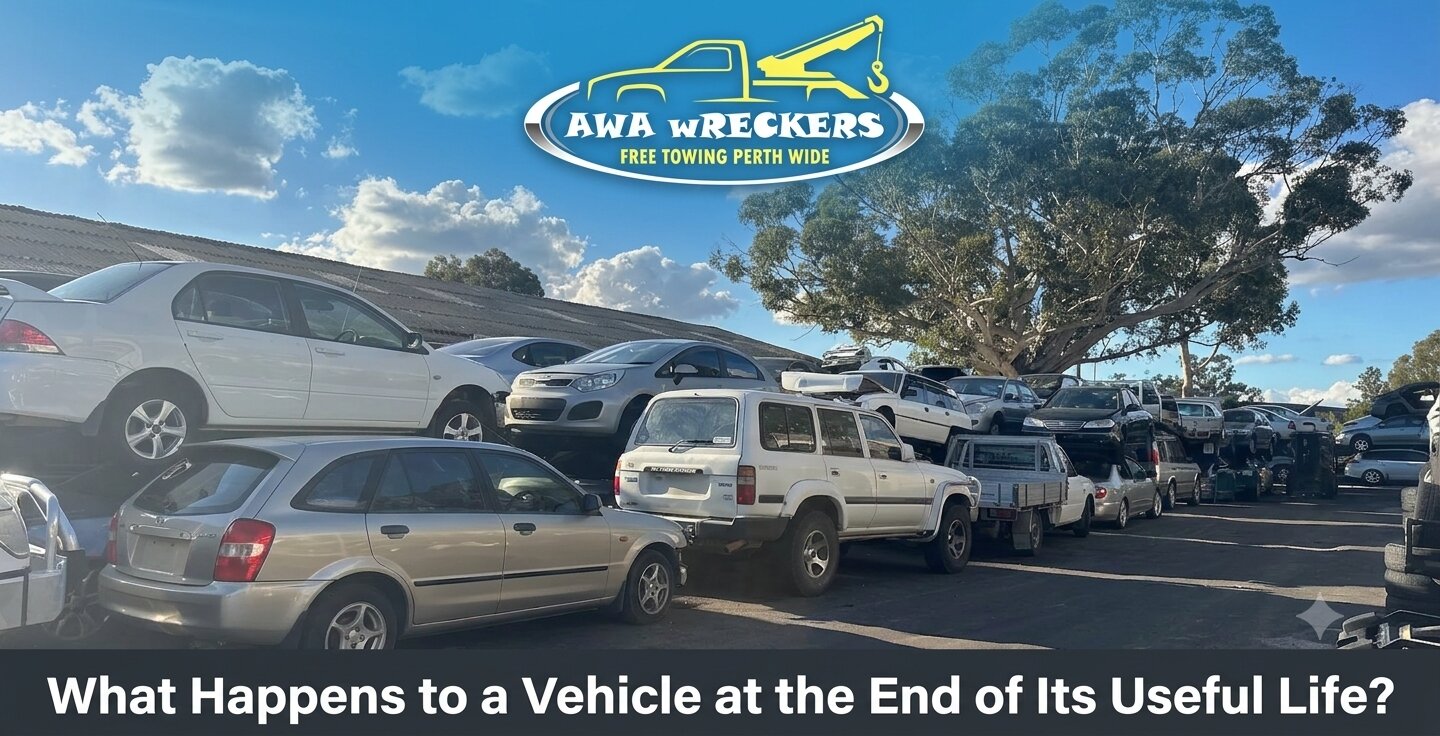
Every vehicle will one day get to a stage where driving it further and repairing it is not economically feasible anymore. Auto wreckers Perth knows that once a vehicle is past its prime use, it can still have reusable parts and material worth recycling even if it cannot be used anymore. Rather than treating the vehicle as garbage, today’s recycling processes strive to maximize the value extracted from it.
When Is a Vehicle Considered End-of-Life?
It is not inevitable for a car to be at the end of its life due to aging. There are various considerations that may affect this judgment such as its condition, its damage, costs of repairing, availability of spare parts, and reliability among others.
A vehicle involved in an accident might be too costly to repair, while an old vehicle will need frequent repairs. A car can also be at the end of its life when major parts become faulty and their cost of replacement outweighs the remaining value of the vehicle. The critical issue is that an end-of-life vehicle contains parts that can serve some purposes.
The Initial Assessment
Before the process of dismantling starts, it is possible to evaluate the car in order to learn about the state of the whole car. This will help to determine what parts can still be used and what material should be recycled.
It is possible to examine such parts of the car as mechanical devices, body parts, electrical systems, wheels, and the internal parts of the car. The unusable parts will be separated from the other parts. This preliminary stage will help to organise the process of dismantling better.
Preparing the Vehicle for Dismantling
Vehicles carry various kinds of materials that should be handled properly before starting the process of dismantling. Fluids, batteries, tires, and other such materials should be treated in a proper manner to decrease the chances of any hazard or problem.
Removal of all this material at an appropriate point helps in safe dismantling of the vehicle and makes it easier to segregate various recovery streams. This becomes very important as vehicles comprise a mixture of materials which cannot be processed in an altogether different manner.
Recovering Reusable Components
One of the best things about vehicle recycling is that it allows for the recovery of components that can still perform for some time. Based on the condition of the car, components such as engines, transmission systems, alternators, starters, mirrors, lights, doors, wheels, and even interiors may be used again.
However, each of those components should be evaluated separately because even those which look good may need some checking to determine whether they are fit for reuse. The recovery of usable components may mean extending the life of already existing materials and avoiding the production of brand new components.
Separating Recyclable Materials
With the identification and removal of these reusable parts from the vehicle, the vehicle that remains consists of many recyclable materials. One of the key recyclable materials found in the vehicle is steel, but other recyclable materials include aluminum, copper, plastics, glass, and rubber. Through separation, these materials can be sent into their respective recycling stream. It is important to separate materials because the processing of mixed materials is not as efficient.
What Happens to the Vehicle Shell?
When all the reusable components have been taken off, the vehicle structure itself can now undergo a material recovery process. The metal parts can now be readied for any further processing, wherein machines will enable the separation of various metals.
These metals, such as steel, and other recoverable materials can possibly be reused as raw materials for manufacturing in the future. This is because the physical vehicle is gone, but not all the materials from the vehicle.
What Happens to Parts That Cannot Be Reused?
It is not possible to recycle each and every part. Certain parts might be too damaged, or worn out, or contaminated, or otherwise unsuitable. Such components must be managed properly nonetheless. According to their nature, they might be sent for recycling, specialist recovery, or proper waste management. Thus responsible disassembly does not consist of the assertion that everything is recyclable. It means that one must identify what is realistically recyclable and manage the rest properly.
Why Vehicle Recycling Conserves Resources
Manufacture of vehicles involves the use of substantial amounts of raw materials. The recycling of materials from vehicles at the end of their lifespan would be instrumental in ensuring that the resources remain in the overall manufacturing process.
The recycling of a relevant part means that the material is put to another use as opposed to being turned into waste. In the same way, the recycling of metals provides the manufacturer with secondary raw materials. Vehicle recycling is thus related to the general concept of resource efficiency.
How the Process Is Becoming More Advanced
Vehicles themselves are becoming more complex too. Modern vehicles contain much more electronics, sensors, special materials, and safety devices than most old vehicles. Along with technological changes in vehicles come problems related to vehicle recycling.
Specialized identification technology, disassembly technology, inventory and sorting technology will be used at recycling facilities in order to cope with the variety of parts. One additional problem comes from electric and hybrid vehicles due to their high-voltage equipment.
Why Responsible Dismantling Matters
Simply leaving behind an unwanted vehicle does not result in the removal of its materials. The unwanted car may decay with time, take up space unnecessarily, and even create environmental issues due to poor handling of the vehicle’s parts and fluids.
Disassembly helps to organize the process. Useful parts of the car can be selected, recyclable materials sorted out, and improper materials directed into their respective handling processes. The aim is to reclaim resources where possible without causing any undue harm to the environment.
Final Thoughts
An end-of-life vehicle does not mark the end of the life of all items within. Even though the car itself may not have any utility left for it, the items that make up the car still might have some utility to them. Using assessment, disassembly, decomponent, and separation of the materials.
The car could go from being an unwanted thing to something that can be used again through the recycling process. With time, vehicle design continues to advance; therefore, the recycling process becomes more necessary.